This is another approach for the beam simulation by using
PHITS (here is an
input file). FLASH radiotherapy has gained attention because of its effects. Compared to conventional radiotherapy, FLASH therapy requests a very short radiotherapy time with an ultra-high dose rate (more than 40Gy/s).
I assumed beam energy = 10MeV, beam current = 250mA, beam pulse length = 12\(\mu\)s, and beam size = \(\phi\)30mm in the
input file. We can accelerate the electron beam with the
TW-accelerator. The geometry is defined as Fig.1 by phig3d (C:\phits\phig3d\windows-x64\phig3d.exe for the default setting).
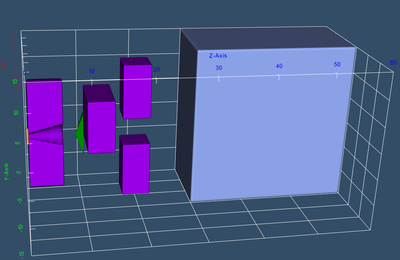
Figure1: The geometry of the settings (cross-section view). Yellow is the target, purple is the collimator, green is the flattening filter made by copper, and blue is the water phantom.
The target is made by tungsten (t=1.5mm) and copper (t=3.0mm). The tungsten will rapidly increase about 85 Celcius degrees by the calculation of below:
\(\displaystyle{\Delta t = Q/ \rho C}\)
where \(Q\) is heat Quantity shows in Fig.2, \(\rho\) is density = 17800kg/m\(^3\), and \(C\) is heat capacity = 132kg K.
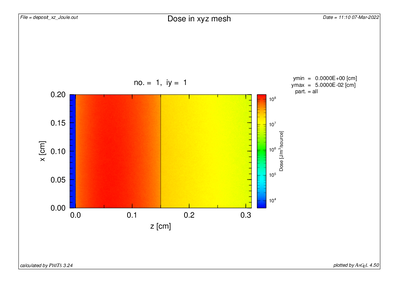
Figure2: Result of heat quantity by PHITS with the unit J/m\(^3\).
When we set SSD = 30cm, the dose distribution shows Fig.3 peaking at at z=31.7cm with 0.12 Gy/pulse. It means we get 40Gy/s with 333 pulses by 0.4% duty factor for FLASH treatment.
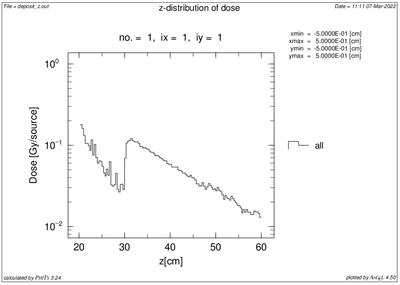
Figure3: The distribution of dose along the z-direction.
As I show in Fig.4, the distribution of the horizontal axis shows a flat photon beam at z=30cm.
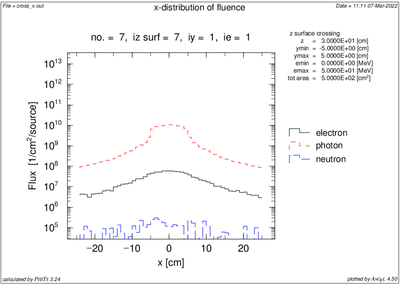
Figure4: The distribution of fluence along the x(horizontal)-direction.
